
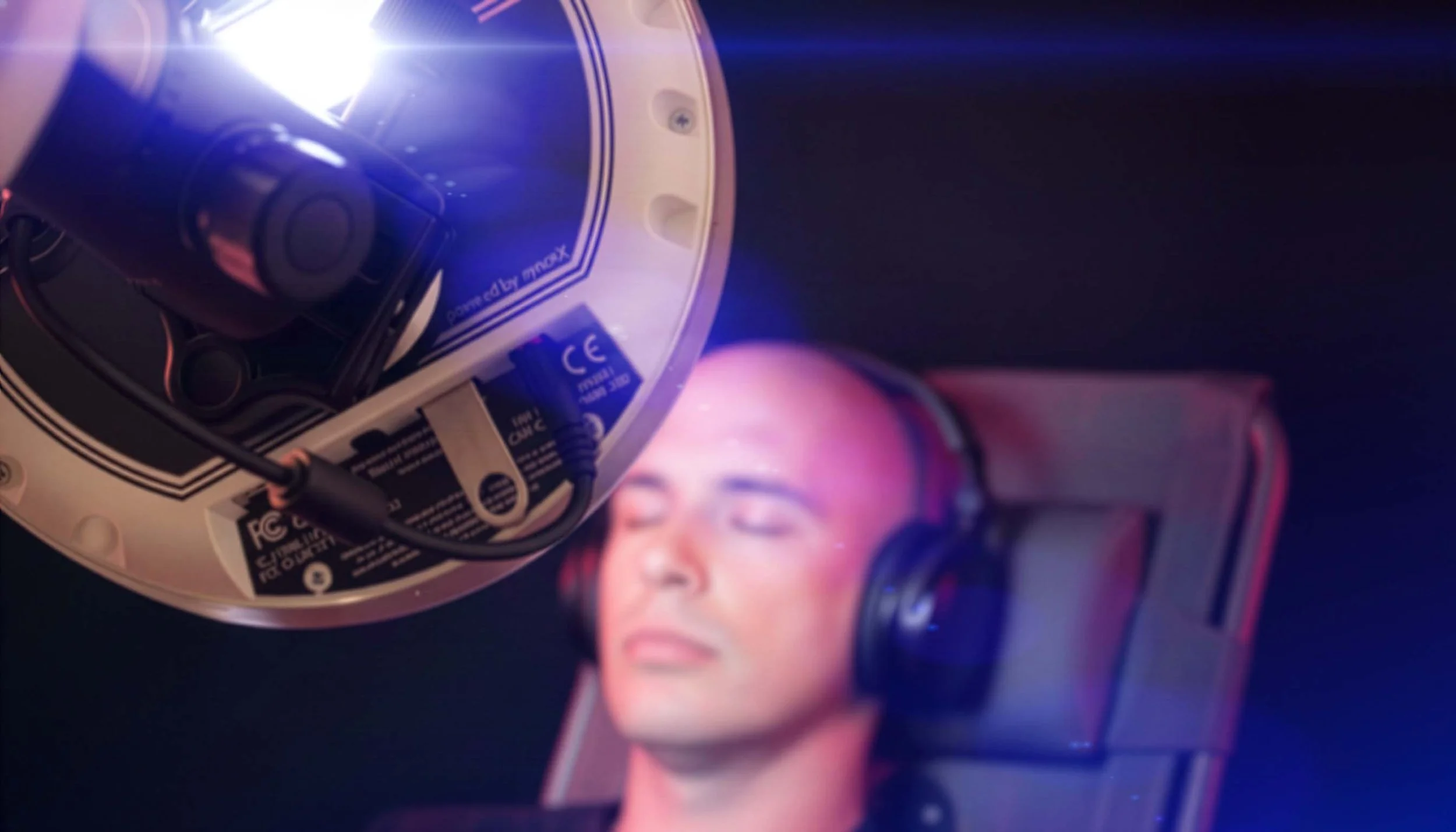
roXiva RX1 Sessions
A specialised lamp that uses precisely timed light and sound to calm a racing mind, clear brain fog, or sharpen your focus — depending on what you need.
What a session feels like
You sit or recline comfortably with headphones on and your eyes closed. The roXiva lamp sits above you and produces precisely timed patterns of flickering light — seen through your closed eyelids — combined with sound.
Your brain naturally tends to follow rhythmic stimuli. The roXiva uses this to guide your brain toward a specific state, depending on the session.
Here's the part nobody expects: with your eyes closed, you'll see vivid colours, moving patterns, and shifting imagery.
It's created by the light interacting with your visual system. Immersive, often beautiful, and unlike anything else. Most people leave their first session a little stunned — in the best kind of way.
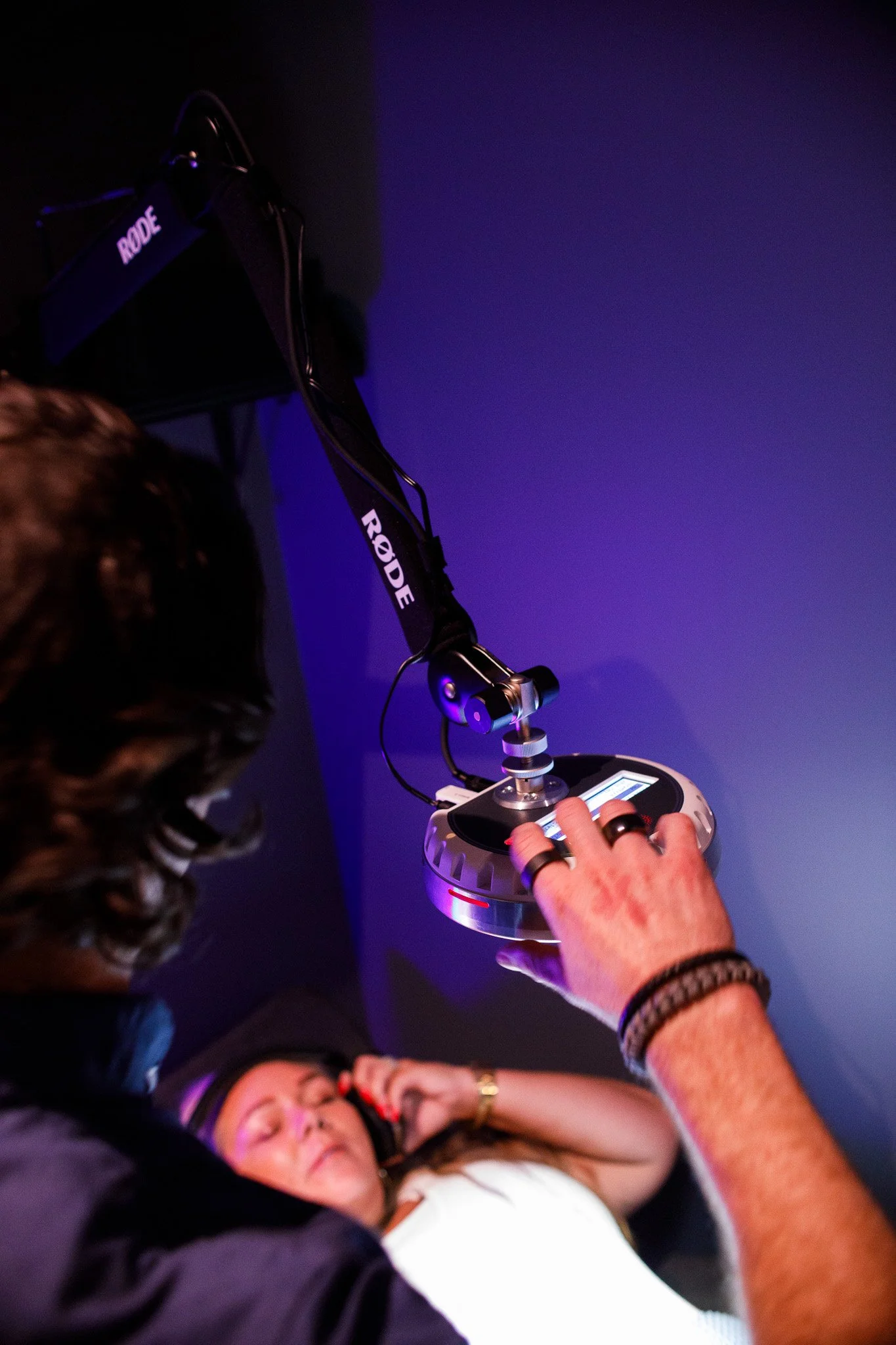
What you walk out with depends on what you came in for
Mind running too hot? The session quiets the noise.
Foggy or mentally drained? The session helps your clarity come back.
Need to be sharp for something important? The session lifts you into focused alertness.
You don't need to do anything. No focus, no meditation, no effort. Close your eyes and let the session run.
Science + evidence
Want to understand the science? Expand the sections below. Don't want to? That's fine — the lamp works whether you read the research or not.
-
roXiva is built around audiovisual brainwave entrainment — the use of rhythmic light and sound to influence large-scale neural oscillations.
Independent neuroscience research shows that:
The brain can synchronise (entrain) to external rhythmic stimuli
Specific frequencies are reliably associated with different cognitive and emotional states
Rhythmic light and sound can produce measurable EEG changes during stimulation
Representative independent sources:
Audio-Visual Entrainment Neuromodulation: A Review of Technical and Functional Aspects (Brain Sciences, 30 September, 2025): https://www.mdpi.com/2076-3425/15/10/1070
Challenges and Approaches in the Study of Neural Entrainment (The Journal of Neuroscience, 2 October, 2024):
https://www.jneurosci.org/content/44/40/e1234242024
This is not speculative neuroscience. Entrainment has been studied for decades in laboratory and medical research contexts.
roXiva applies this principle deliberately and reproducibly, without requiring meditation skill or sustained effort.
-
Evidence relevant to roXiva comes from two sources.
1. Independent research on audiovisual entrainment, showing:
EEG frequency shifts during stimulation
Short-term changes in attention, relaxation, or arousal depending on protocol
High inter-individual variability in response
Examples:
Effects of audiovisual interactions on working memory: Use of the combined N-back + Go/NoGo paradigm (Frontiers in Psychology, 17 February 2023): https://www.frontiersin.org/journals/psychology/articles/10.3389/fpsyg.2023.1080788/full
Lightening the mind with audiovisual stimulation as an accessible alternative to breath-focused meditation for mood and cognitive enhancement (Scientific Reports, 26 October, 2024):
https://www.nature.com/articles/s41598-024-75943-8
2. Company-sponsored and observational data, including:
Internal EEG recordings demonstrating entrainment during sessions
Client-reported outcomes describing improved access to calm or focused states with repeated use
As with most brain-state tools:
Sample sizes are often modest
Outcomes are sometimes subjective by necessity
Short-term state change is easier to demonstrate than long-term trait change
We therefore position roXiva as a state-access tool, not a permanent rewiring device.
-
Although forms of stroboscopic light have been used in medical settings (see study below), roXiva as used at Cheatcode Playground is best understood as a tool for deliberate brain-state access, not therapy or self-improvement by force of will.
In practice, clients use roXiva to:
Enter focused or calm states more reliably
Audiovisual entrainment provides an external scaffold that nudges the brain toward a target rhythm, rather than relying on effort or technique.Build familiarity with specific states
Repeated exposure can make certain states (e.g. relaxed focus, calm alertness) easier to recognise and re-enter later without the device.Reduce cognitive noise
Independent studies associate entrainment with reductions in mind-wandering and improved attentional stability during stimulation.
Relevant background reading:
A randomized controlled trial (RCT) to explore the effect of audio-visual entrainment among psychological disorders (Acta Biomedica, 19 January, 2022):
https://pmc.ncbi.nlm.nih.gov/articles/PMC8823583/#:~:text=Acta%20Biomed
Alongside the other two devices:
roXiva influences brain state directly
Shiftwave improves the ability to move between states
NanoVi supports the biological recovery that makes those states sustainable
Each works at a different layer of the same system.
-
Limits of the evidence
Entrainment effects are strongest during and shortly after sessions
Long-term trait change is variable and context-dependent
EEG synchronisation does not automatically equal insight or behavioural change
roXiva is not for
Anyone expecting permanent transformation from passive exposure
Anyone uncomfortable with rhythmic light stimulation, especially those with photosensitive epilepsy
Anyone seeking medical care for a neurological or psychiatric diagnosis
roXiva works best when used intentionally, with a clear aim for the session, and as part of a broader regulation and recovery strategy.
How roXiva pairs with the other devices
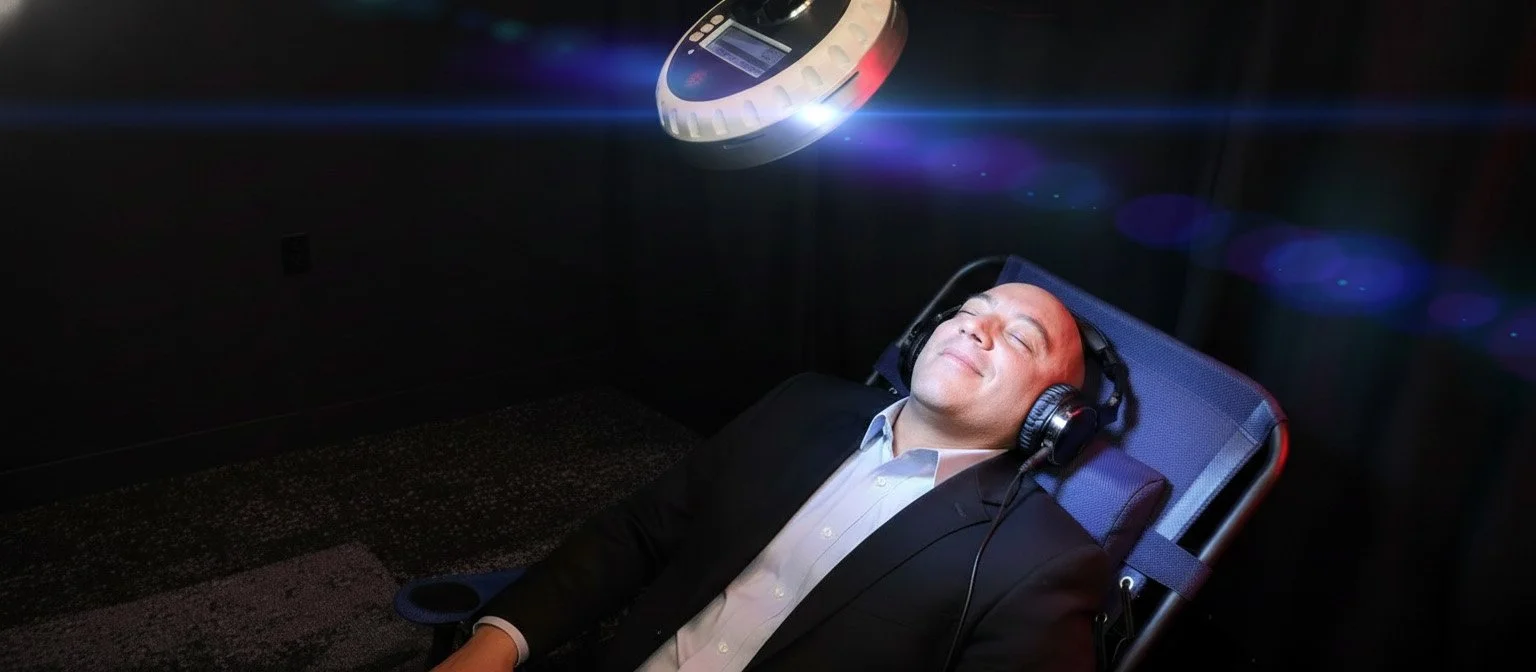
With Shiftwave
roXiva works on your brain. Shiftwave works on your body. Running them together means we're shifting you from both directions at once — the light guiding your mind while the chair steers you physically. Faster, deeper, more coherent shifts than either device alone.
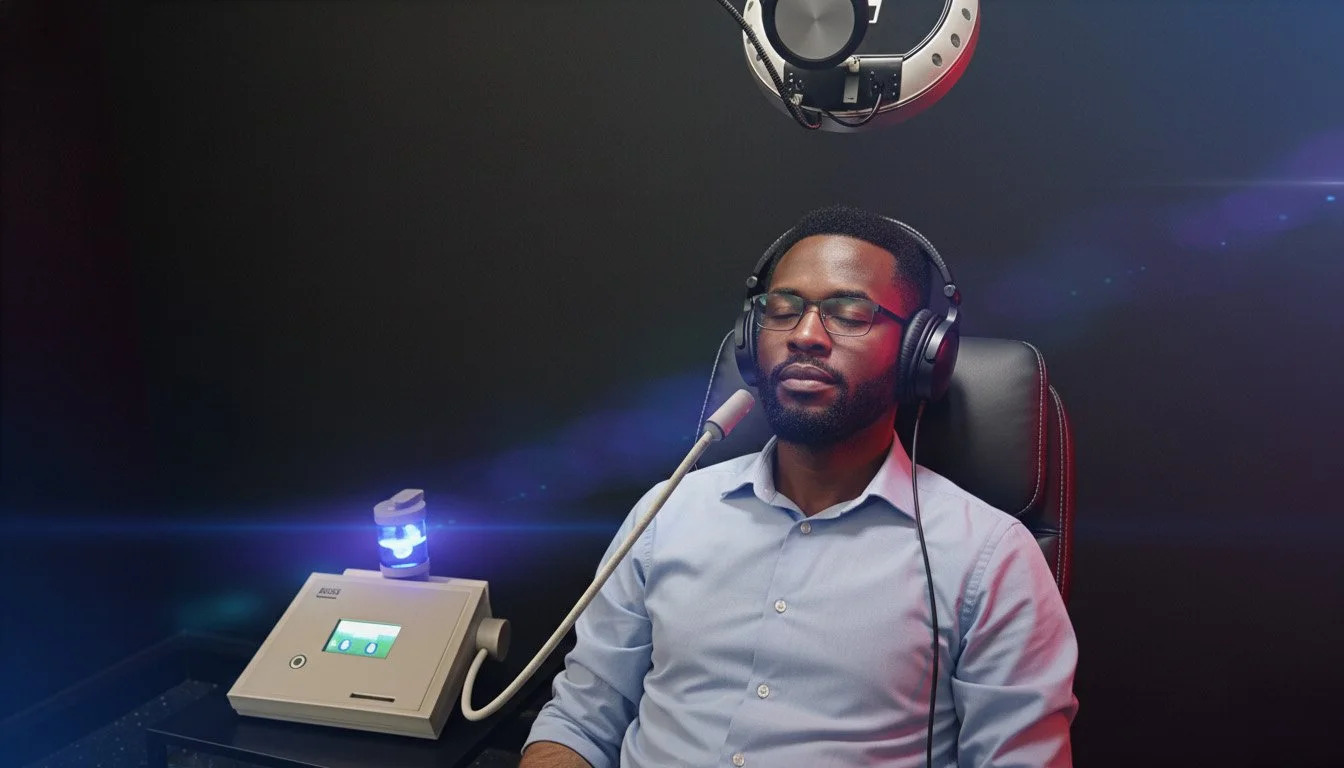
With NanoVi
roXiva changes how your mind is operating right now. NanoVi supports the recovery underneath — the cellular repair that makes mental clarity sustainable. Running them together means sharper thinking that holds, not a short-lived lift followed by a crash.